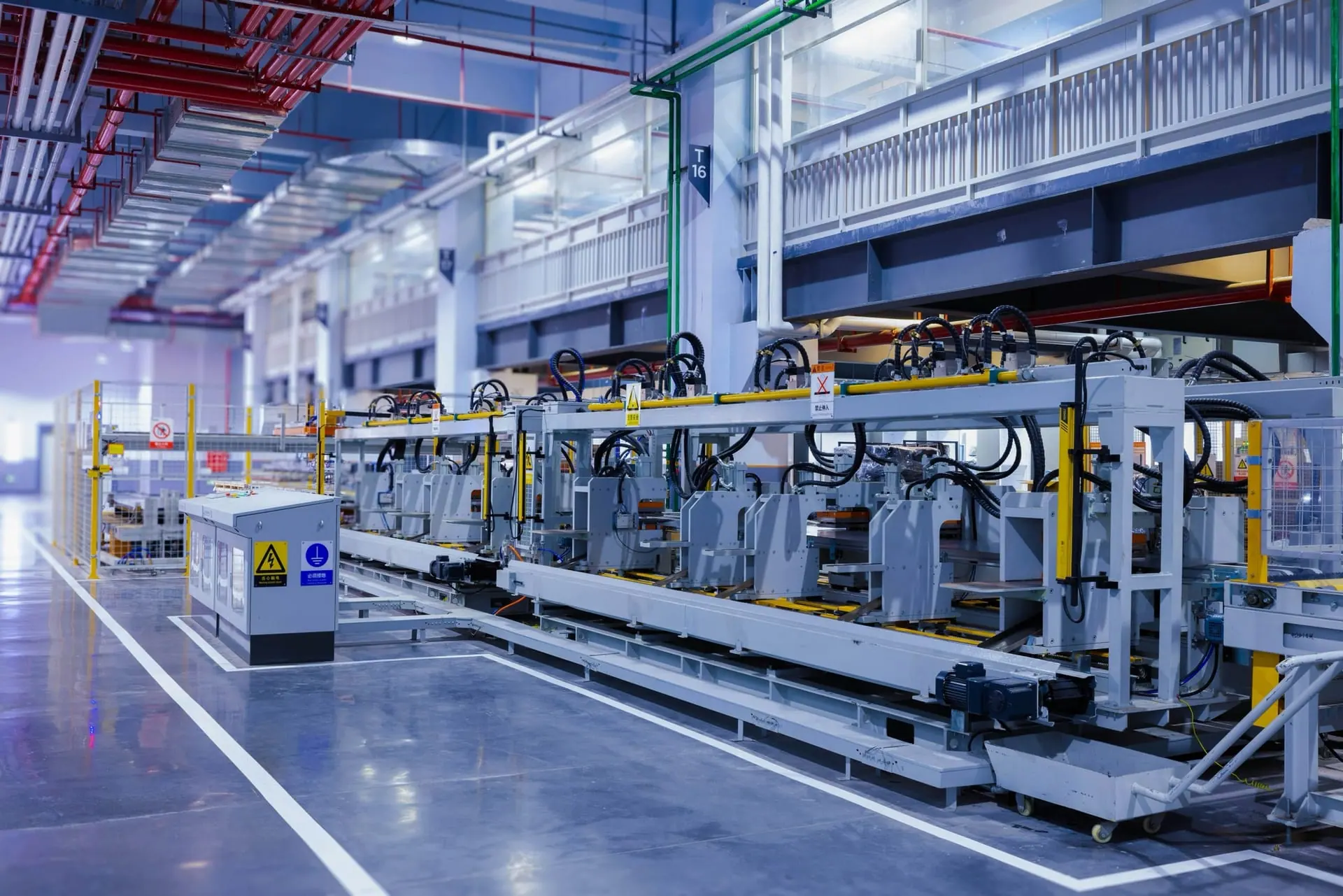
In the morning operations meeting of a distribution center, the sentence heard most often concerns a shortage of space; the rack occupancy report for the same facility, meanwhile, tends to show a figure somewhere between sixty and seventy percent. What is observed on the floor tells a different story: trailers queued in front of the receiving doors, pallets set down temporarily in aisles and not yet put away, orders staged in the shipping area waiting to be consolidated, and forklifts changing direction continuously between two competing tasks. The warehouse manager requests additional space, finance questions the rent increase, and the commercial side raises the pressure that late shipments are creating with customers; each of the three is correct on its own data, precisely because none of them is measuring the same quantity.
The less frequently noticed feature of this picture is that the congestion is compressed into a window of two or three hours rather than distributed across the working day. Supplier vehicles typically arrive early in the morning, scheduled around their own loading programs, while customer shipments concentrate in the afternoon, dictated by the evening departure times of the carriers. During the hours where these two patterns intersect, the same ramps, the same equipment, and the same labor pool are required to serve bidirectional demand simultaneously. For the remainder of the day the facility may be breathing comfortably; performance, however, is a quantity determined by the narrowest window rather than by average utilization.
The mechanism that deserves to be named at this point is warehouse congestion — the locking of warehouse capacity, independent of physical fill level, when inbound and outbound flows load the same shared resource within the same interval. At its core sits not space but the fundamental behavior of queues: once utilization of a shared resource passes a certain threshold, waiting time grows exponentially rather than linearly. Where a forklift pool runs at sixty percent average daily utilization but climbs to ninety-five percent during two critical hours, the delay created in those two hours is not recovered by the slack in the rest of the day, since the departing vehicle has already left and the delayed receipt has been inherited by the following day's schedule.
The second layer of the mechanism lies in the self-reinforcing nature of temporary staging. When put-away is deferred because capacity is constrained, the pallet is set down in an aisle or a buffer area; that pallet will now be handled twice, and where it rests it narrows the travel path of some other movement. Every deferral therefore raises total workload and simultaneously reduces the yield of the capacity that remains. Beyond this point the system begins producing its own queue, and viewed from outside the problem presents itself as insufficient space, whereas what is actually observed is the physical accumulation of deferred work.
Reading this tendency purely as a defect would be inaccurate, since concentrating flows is rational under certain conditions. Gathering supplier vehicles into a narrow window lowers inbound freight cost, stacking shipments toward the evening enables carrier consolidation, and holding staff within a single shift stabilizes labor expense. These choices genuinely reduce cost for as long as demand volume stays below the facility's narrow-window capacity. The difficulty resides not in the shortcut itself but in the persistence of an established schedule after volume grows, SKU count widens, or lines per order rise; the condition has changed while the configuration has not.
The institutional cost surfaces first not in the rent line but in labor and transportation. Overtime hours become permanent as a means of closing work that the narrow window cannot absorb; detention and waiting charges paid on queued vehicles disperse inside the logistics expense line and lose visibility; delays that convert into expedited shipments are settled above standard tariff. Examined separately, each of these three items looks manageable, yet their common origin is a single temporal overlap, and no budget report renders that common origin visible.
The second layer of cost sits on the commercial side and weighs more heavily. Missing a shipping cut-off depresses the order fill rate; a declining fill rate drives safety stock increases at the customer, followed by less frequent ordering in larger batch sizes. The consequence is that the flow arriving at the warehouse becomes still more volatile — congestion, in other words, regenerates its own cause through customer behavior. In structures serving retail or chain accounts, penalty provisions tied to delivery-window violations enter the picture as well, and such provisions typically reside in the commercial terms section of the contract, in a location the operations team does not read on any regular basis.
The third layer concerns the misdirection of the investment decision. Where congestion is diagnosed as a space problem, what reaches the organization is a proposal to lease additional warehousing, build a mezzanine, or construct a new facility, each of which commits capital or long-term lease obligation. So long as the temporal overlap remains unresolved, that investment does not eliminate congestion but repeats it at greater scale; moreover, an operation split across two locations generates additional transfer movements between them and raises total workload. Leaving this distinction unasked at an investment committee table fixes a structural error that a mid-sized distribution network will then carry across several years of depreciation.
The mechanism that neutralizes this tendency is not individual effort or shift discipline but a change in the unit by which capacity is measured. The applicable intervention separates into four components: first, defining capacity as movements processed per unit of time rather than as square footage or pallet positions, with the narrowest window of the day reported separately; second, establishing a binding appointment system for receiving and shifting supplier arrival times outside the shipping cut-off hours; third, splitting order picking into waves so that equipment and labor demand is distributed across the day; and fourth, treating temporary staging areas not as a standing tolerance but as an indicator that triggers a decision once its threshold is exceeded.
BEIREK's intervention in structures of this kind begins not with operational improvement recommendations but with rebuilding the evidentiary basis on which the decision will rest. We construct the facility's hourly movement profile with inbound and outbound separated, measure window-based utilization of the shared resources — doors, equipment, personnel — and produce a record that distinguishes whether the congestion originates in space or in scheduling. That record places, alongside the request for additional space that arrives at the investment committee, the concrete question of whether the same outcome can be produced without capital expenditure.
The second line of intervention exists so that the decision does not remain a one-off analysis. We tie indicators such as appointment compliance rate, window-based resource utilization, temporary staging occupancy, and cut-off violations to a monthly review rhythm, and make visible the relationship between those indicators and the contractual delivery commitments and penalty clauses they ultimately govern. As with capital-intensive facility decisions generally, what proves decisive here is not identifying a single correct answer but establishing a monitoring architecture that causes the configuration to change when the condition changes.
A warehouse's real capacity is defined not by how much goods it can hold but by how many movements it can complete during its busiest two hours without forming a queue. When a request for additional space reaches a board, the question worth asking is not whether the facility is full, but at which hour and on which shared resource that fullness appears; every square foot approved before that question is asked purchases a more expensive copy of an unresolved scheduling problem.